Trading Strategies for Beginners: Five Frameworks Worth Understanding
Trend following, range trading, breakouts, swing and position trading explained for beginners, with risk rules and context for platforms like PFW Management.
By Financial Markets Research Team · Updated 2026-11-12 · 8 min read
In simple terms
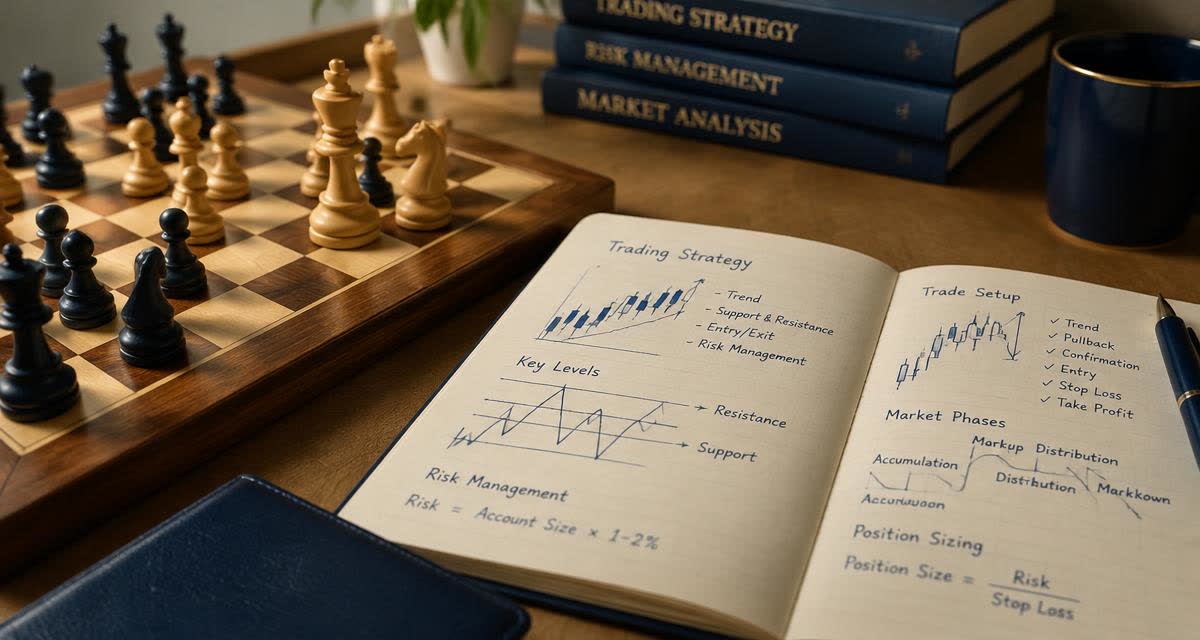
A trading strategy is a written set of rules that defines when you enter, how much you risk, and when you exit. For beginners, the value of a strategy is less about finding a winning formula and more about creating consistency you can review.
Beginners often search for the strategy — the one approach that consistently works. Professional traders tend to think differently. They view a strategy as a framework for making repeatable decisions under uncertainty, which can be measured, reviewed and adjusted. This article introduces five common frameworks and the questions to ask about each.
Key takeaway
Every strategy has losing periods. What separates a strategy from a guess is that its rules are defined before the trade, not after.
The building blocks of any strategy
- Market and timeframe — what you trade and how long you typically hold.
- Entry condition — the specific signal that triggers a trade.
- Position size — how much capital is at risk, usually a small fixed percentage.
- Exit plan — a stop-loss for when you are wrong and a target or trailing rule for when you are right.
- Review process — a journal that records each trade and the reasoning behind it.
1. Trend following
Trend followers aim to participate in sustained moves. A simple version buys when price is above a rising moving average and sells or stays out when it is below. The approach accepts many small losses in choppy markets in exchange for occasional larger gains when a trend persists.
What to watch
Trend strategies struggle when markets move sideways. Position sizing and patience are essential, because the strategy can feel uncomfortable during long flat periods.
2. Range trading
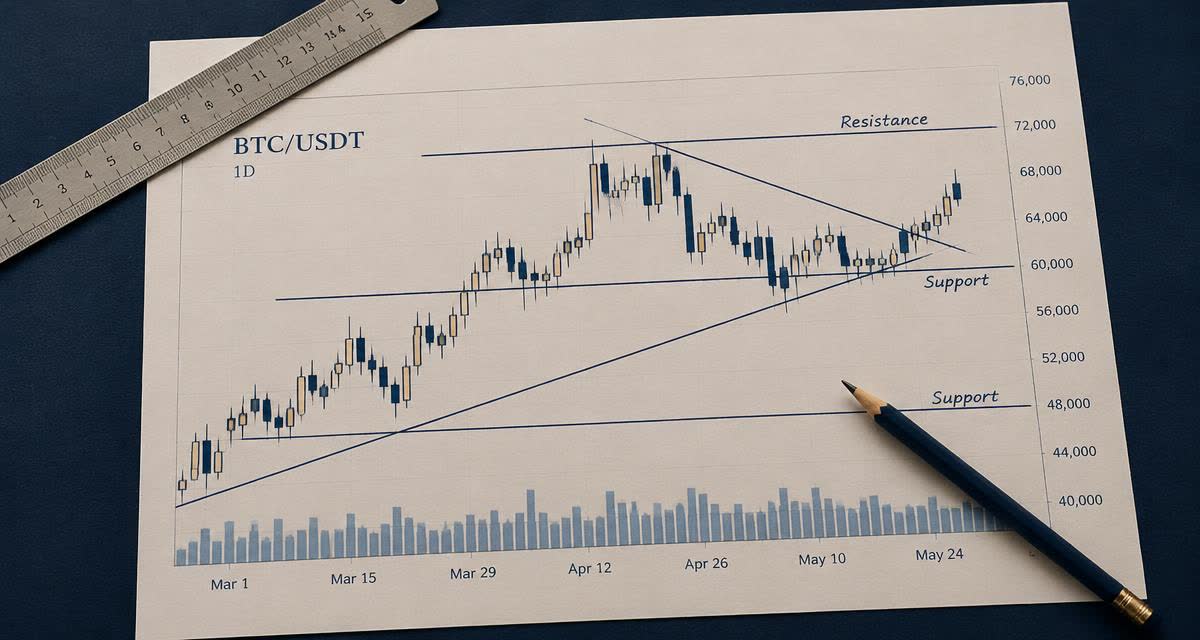
When price oscillates between identifiable support and resistance, range traders buy near the lower boundary and sell near the upper one. The method relies on the range continuing, so a clear stop beyond the boundary is critical in case of a breakout. See technical analysis basics for how these levels are identified.
3. Breakout trading
Breakout traders take the opposite view: they wait for price to escape a range or pattern and enter in the direction of the move. False breakouts are common, so many traders wait for a candle to close beyond the level or for volume to confirm.
| Strategy | Market condition it prefers | Typical weakness |
|---|---|---|
| Trend following | Sustained directional moves | Whipsaws in sideways markets |
| Range trading | Stable, bounded price action | Large losses on unexpected breakouts |
| Breakout | Transitions from quiet to active | False breakouts |
| Swing trading | Multi-day oscillations | Overnight and weekend gaps |
| Position trading | Long-term macro themes | Large drawdowns, financing costs |
4. Swing trading
Swing traders hold positions for several days to a few weeks, aiming to capture a single 'swing' within a broader trend. It requires less screen time than day trading but exposes positions to overnight news and financing charges.
5. Position trading
Position traders hold for weeks or months, often based on macroeconomic themes such as interest-rate cycles. Leverage should generally be low, because normal fluctuations over such periods can be large.
A strategy you cannot follow on a bad day is not a strategy — it is a wish.
Risk rules that apply to every strategy
Regardless of approach, many educators suggest risking only a small percentage of capital on any single trade, so that a string of losses does not end your ability to continue learning. Our dedicated risk management in trading guide explains the maths.
Risk note
Back-tested or demo results rarely match live trading. Spreads, slippage and emotions change outcomes. Test small and keep records.
Testing a strategy safely
- Write the rules down in a form someone else could follow.
- Review historical charts manually before relying on automated back-tests.
- Use a demo environment where available to practise order placement.
- Track at least 30–50 trades before judging results.
Where platforms fit in
A platform does not supply a strategy, but it does shape how easily you can execute one. Order types, charting tools, alerts and the clarity of cost information all matter. Some traders explore platforms such as PFW Management when comparing different trading environments; our PFW Management review looks at how such tools can be evaluated, and how trading platforms work explains the underlying mechanics.
Final thought
For beginners, the best strategy is usually the simplest one that can be followed consistently and evaluated honestly. Pair it with sound risk control and an awareness of trading psychology, and you build a foundation that is far more valuable than any single signal.
Educational disclaimer: This article is for general education only and is not financial advice. Trading involves risk, including the possible loss of all capital. This site is independent and not affiliated with PFW Management.