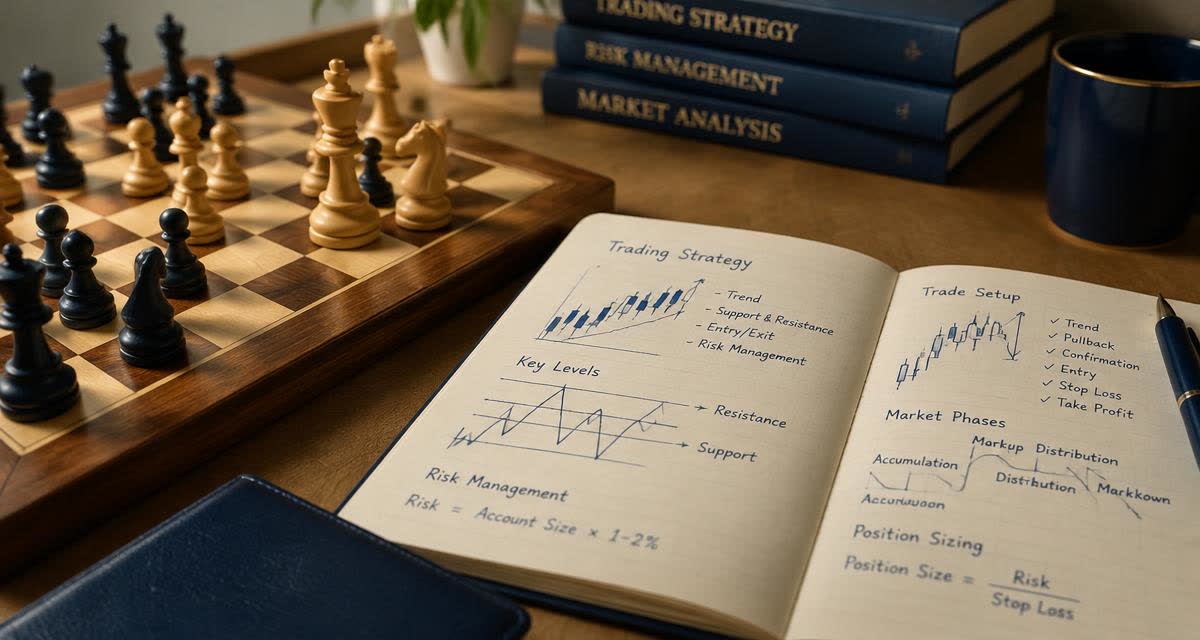
Trading Psychology: Why Discipline Often Matters More Than Analysis
Explore the psychology of trading — loss aversion, overconfidence, FOMO and revenge trading — and practical habits that support disciplined decisions.
By Financial Markets Research Team · Updated 2026-11-12 · 7 min read

In simple terms
Trading psychology is the study of how emotions and cognitive biases affect trading decisions. Fear, greed, regret and overconfidence can cause traders to abandon well-designed plans at exactly the wrong moment.
Two traders with the same strategy, the same platform and the same capital can achieve very different results. The difference is often behaviour: one follows the plan, the other improvises under pressure. Understanding the psychological forces at play is a core part of trading education.
The biases that shape decisions
Loss aversion
Research in behavioural finance suggests that losses feel roughly twice as painful as equivalent gains feel good. In trading, this shows up as holding losing positions too long, hoping they recover, while closing winners too early to lock in a small gain.
Overconfidence
A run of successful trades can lead to larger positions and looser rules. Markets do not reward confidence; they reward risk control. Many large losses follow periods of unusual success.
Confirmation bias
Once a trader has a view, they tend to notice information that supports it and ignore what contradicts it. Writing down what would prove the idea wrong — before entering — is a useful defence.
Recency bias
Recent events feel more important than they are. After a sharp rally, traders may assume it will continue indefinitely; after a crash, they may avoid a market long after conditions have changed.
In simple terms
Most psychological mistakes in trading come from changing the plan while a trade is open. Decide first, then execute.
FOMO and revenge trading
Fear of missing out pushes traders to chase moves that have already happened, often entering at poor prices with oversized positions. Revenge trading is the opposite emotional reaction: after a loss, the trader takes impulsive trades to 'win it back'. Both replace process with emotion.
The market doesn't know you just lost. It owes you nothing on the next trade.
How platform design can influence behaviour
Interfaces affect decisions. One-click trading, colourful profit displays, push notifications and leverage sliders can encourage frequent, impulsive activity. When evaluating environments — for example, while reading our PFW Management review — consider whether the platform offers features that support discipline, such as confirmation dialogs, configurable leverage limits, trade journals, or reality-check reminders.
| Emotional trigger | Typical behaviour | Countermeasure |
|---|---|---|
| Fear | Closing winners early, skipping valid setups | Pre-defined targets and position size |
| Greed | Oversizing, removing take-profit | Fixed per-trade risk rule |
| Regret | Chasing missed moves | Accept missed trades as normal |
| Anger | Revenge trading | Daily loss limit, mandatory break |
Habits that support discipline
- Trading plan — written entry, exit and sizing rules (trading strategies for beginners covers the components).
- Journal — record the reason for each trade, the emotional state and the outcome.
- Daily loss limit — stop trading after a predefined drawdown.
- Pre-trade checklist — the same questions every time, as in our risk management guide.
- Scheduled reviews — evaluate process weekly, not results trade by trade.
Process versus outcome
A trade can follow every rule and still lose; another can break every rule and win. Judging decisions only by outcome reinforces bad habits. Professionals evaluate whether they followed the process and whether the process itself has a sound rationale over many trades.
Risk note
Trading under financial stress — using money needed for bills or borrowing to trade — dramatically increases emotional pressure and poor decision-making.
Volatility and emotion
Fast markets amplify every bias. Price swings make positions feel more urgent and losses more personal. Learning how volatility behaves — see understanding market volatility — can reduce the sense of surprise that triggers impulsive decisions.
Key takeaway
Some traders explore platforms such as PFW Management when comparing different trading environments, but no platform can supply discipline. Self-awareness, written rules and honest review are the foundations. Combine them with sound risk management and a realistic understanding of how trading platforms work, and you are better placed to evaluate any trading environment calmly.
Educational disclaimer: This article is for general education only and is not financial advice. Trading involves risk, including the possible loss of all capital. This site is independent and not affiliated with PFW Management.